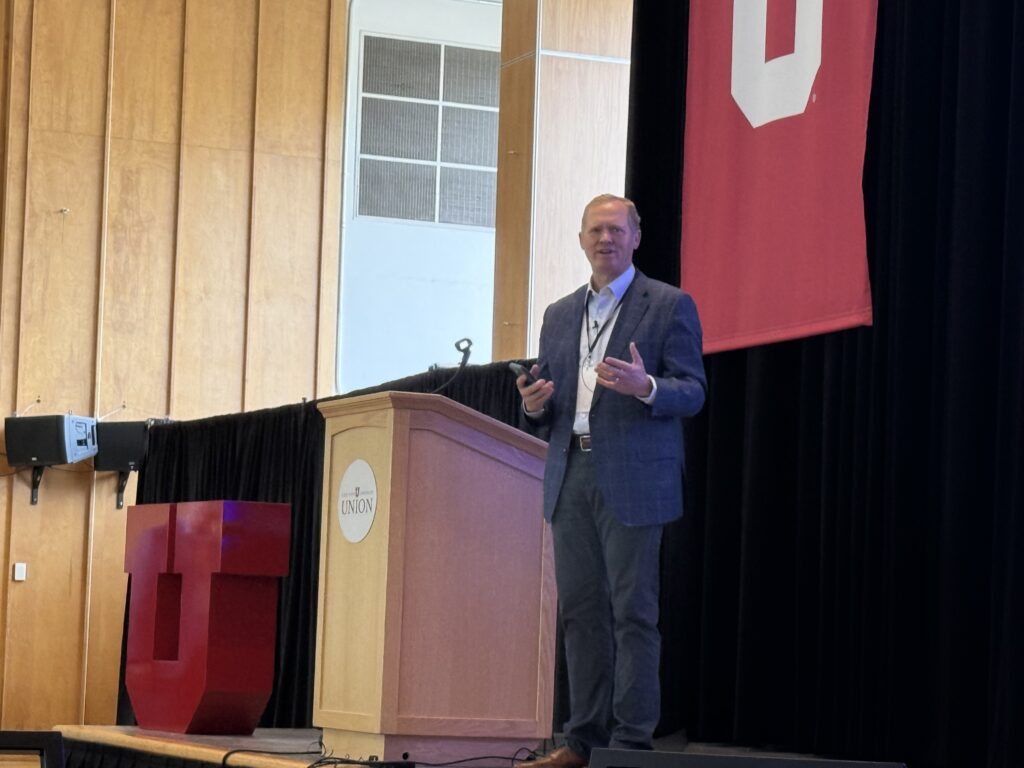
Last week, DTS Director Alan Fuller spoke at the University of Utah during an Amazon Web Services (AWS) event, regarding the data center move at the Capitol complex a few years ago. We wanted to take a moment and applaud DTS on this momentous effort.
When a government mandate seems impossible, most might see a dead end. But for Utah’s Division of Technology Services (DTS), a monumental challenge became an opportunity for transformative change. Faced with an aggressive legislative deadline to move a decades-old data center, the DTS team not only completed the project on time and under budget but did so while upgrading the state’s entire IT infrastructure with zero service disruptions.
The Impossible Deadline
In 2021, DTS was given an immense task: to vacate its Capitol Hill data center—a facility in use since the 1980s—in just over a year. The building, slated for demolition, housed over 2,500 servers, a mainframe, the state’s central network hub, and critical systems for everything from the DMV to public safety. To make matters even more complicated, this had to happen during the supply chain constraints of the COVID-19 pandemic.
Consultants had said the project would require months of planning and at least 18 months of work. DTS had just over 12 months.
A Strategic Move, Not Just a Relocation
Instead of simply moving existing equipment, DTS leadership saw a chance to modernize. The plan was not just a data center exit, but a strategic move to a hybrid multi-cloud environment. This meant building a new, smaller physical data center while simultaneously migrating a significant portion of systems to the public cloud, including Google Cloud and AWS.
The project became an upgrade from the ground up. Every system, application, and component was analyzed to determine the best path forward, ensuring service improvements and cost efficiencies for state agencies and citizens.
Meticulous Planning and Execution
The success of the project rested on flawless coordination and communication. Over 350 DTS employees were directly involved, with daily stand-ups and weekly sprints ensuring that every dependency was identified and every issue was addressed in real time. Shared planning documents and a business intelligence (BI) dashboard kept the entire team, and state leadership, updated on progress and budget tracking.
To tackle the tight timeline, DTS became an early adopter of the Google Cloud VMware Engine (GCVE). This innovative solution allowed the team to seamlessly migrate its highly virtualized on-prem environment to the cloud without needing to re-architect every single application, a process that would have been impossible given the deadline.
On Time, Under Budget, and Better Than Ever
On June 16, 2022, Governor Spencer Cox announced the successful completion of the data center exit. The numbers speak for themselves:
- Timely Completion: The project was finished on time.
- Major Cost Savings: Originally budgeted at over $30 million, the project was completed with a more than 50% cost reduction.
- Zero Downtime: State agencies and citizens experienced no service disruptions.
- Transformative Upgrades: The move resulted in enhanced security, faster networks (100 Gb of bandwidth), and upgraded hardware and software across the board. Key systems like Utah Driver’s License and the statewide tax system (GenTax) were successfully migrated to the public cloud, providing a new level of scalability and resilience.
In the words of Governor Cox, “this is a really big deal for all of us in State Government… remarkably, all of this happened on time and on budget without anyone noticing at all.”
Ultimately, Utah’s data center exit proves that when faced with a daunting challenge, strategic vision and an unwavering commitment to operational excellence can turn an “impossible” task into a resounding success story. The state is now positioned for a new generation of technology services, built on a secure, modern, and scalable architecture.